
























You write a Hub Pass to go to the bathroom, and there you smell something unexpected.
You decide to mind your own business, but a para rushes in and tells you that you have to go down to the Student Affairs office. Apparently, the vape detector has gone off. You go down, you get checked, but nothing is found. Finally, you are released, and return to class half an hour later.

This is a much more common experience than many realize. At Minnetonka High School, each bathroom has a vape detector, which often goes off, involving innocent students. This begs the question, is this system the best it can be?
For those who are unfamiliar with the vape detection process, Addy Thibodeau, ‘26, who has had 3 personal experiences this year getting flagged, details the process: “You have to wait outside the bathroom with the para until everyone comes out. You then walk down to the Student Affairs office, wait for an assistant principal to come in and look at the security footage and either clear you or talk to you.” But Thibodeau has been relatively lucky, as she has been cleared every time since she walked into the bathroom after the sensor went off.
Another student, Nicholas Schroeder, ‘26, was involved in a similar incident back in sophomore year. Schroeder says that one day he left the bathroom, and “a para pulled [him] aside and told [him] that the vape detector went off, and that he was there to take [him] to the student affairs office in order to make sure that [he] was okay to return to class.” Schroeder was deemed another bystander, and was also quickly cleared as the detector went off before he arrived.
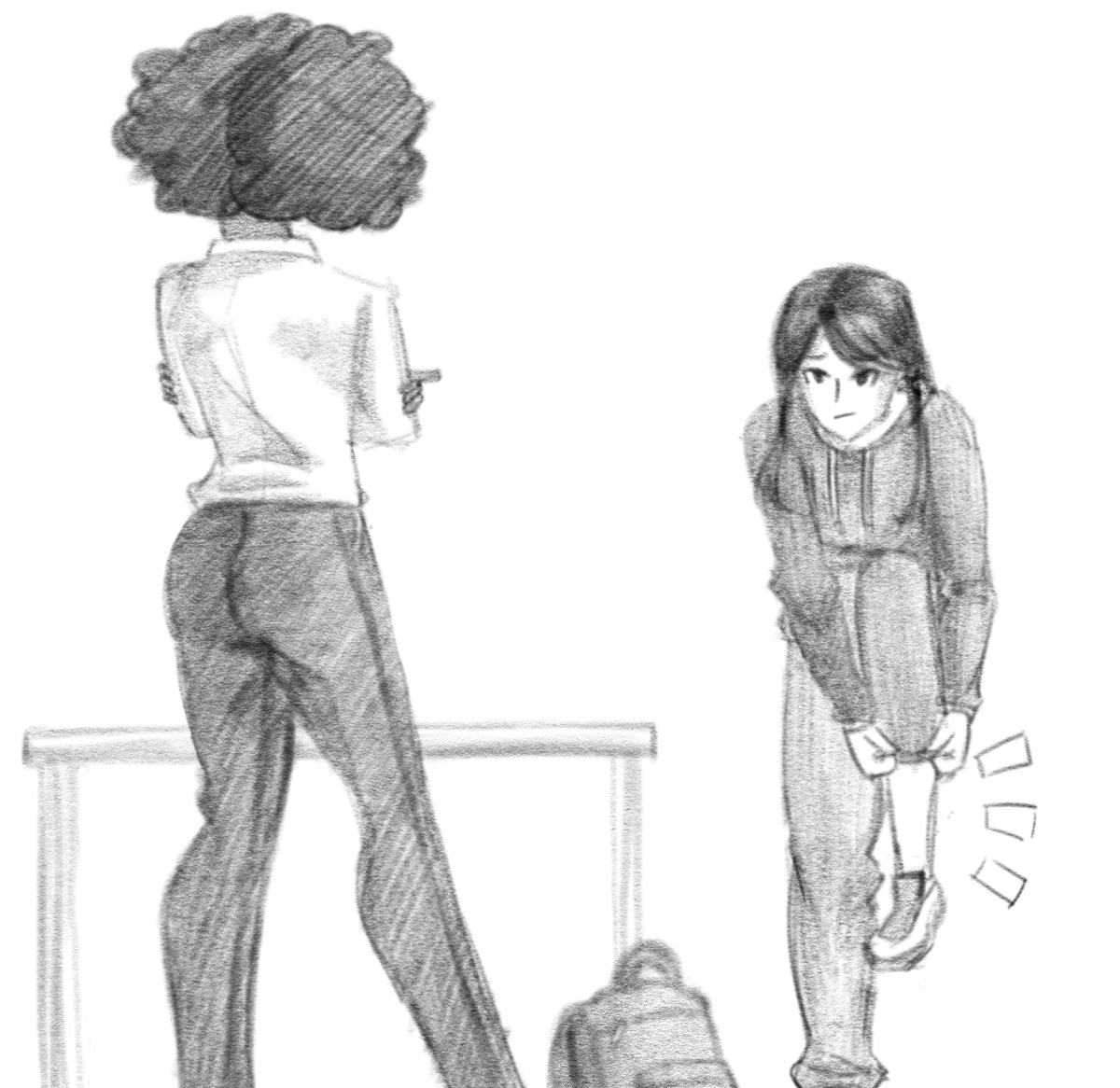
However, this is not the story with Annie Tan, ‘26, who had an experience earlier this year. Tan recalls how, “when [she] walked out of the bathroom, about four other girls were also funneled to the side.” She was then brought down to the Student Affairs office, where “they brought [her] into a room, and they asked a couple of things.” According to Tan, “they had me check for certain parts of my clothing, […] they asked me to lift up the cuff of my pants or to dump out [my] shoes or [my] pockets and all that.” And even though nothing was found on Tan, nor on the other girls who were flagged down, the detector going off ended up taking valuable time. Tan states that “it was [the] passing time before I had a test,” and that “I asked to get the whole process done first because I literally had a test going on.”
These sensors are notorious for giving false alarms and causing students to get caught up in a time-consuming process. But to understand how they are so frequently wrong, we asked Assistant Principal Alex Hinseth how they work. Hinseth stated that, “they are in the ceiling and they detect the presence of smoke, vape particles, and other things like loud noises. And so when that happens, we get a notification.” This reveals a possible issue. For example, Aleah Trojan, ‘26, believes that false alarms happen more with girls than guys, and that this might be because the vape detectors may be triggered by perfume. In Trojan’s opinion, “perfume can make the alarms go off and girls use more perfume than guys, so that can be a contributing factor.”
Overall, Hinseth believes that, “[the vape detectors] are really helpful. One of the biggest reasons we have them is so that students who use the restroom who aren’t vaping feel comfortable in there.” Furthermore, Hinseth notes that, “there are very few false positives” and that, “when we notice an abnormal pattern, we investigate and have them reset.” However, even if they are properly detecting smoke, given how many times these detectors involve innocent students, one may wonder if the detectors truly make the bathrooms a better place.

