




















History
By Teagan Welsch
Jack-o’-lanterns are a longstanding Halloween tradition. Often placed outside of homes to create a festive entrance and to welcome trick-or-treaters, these petrifying pumpkins actually have a much deeper history.
The tale of Stingy Jack is an ancient Celtic folktale dating back hundreds of years. The legend tells the story of a man cursed to spend eternity roaming the Earth after a deal with the Devil went south. A mischievous and deceiving man, Jack tricked the Devil into not collecting his soul until ten years after their first encounter, when Jack fooled the Devil again, making him promise to never take his soul. When Jack finally died, it’s said that he was refused entrance to heaven for his bad deeds, and to hell due to his botched deal with the Devil, causing him to be cursed to wander Earth forever. He was given a carved turnip lit with fire as a lantern to guide his way, establishing jack-o’-lanterns within Celtic mythology.
Because of this folktale, the Irish were known to adorn the front of their homes with carved turnips—illuminated by burning coals or candles—to ward off evil spirits. In the 19th century, as many Irish people immigrated to the United States, they brought this tradition with them. The Irish, however, quickly found that pumpkins were more readily available and easier to carve, creating the jack-o’-lanterns that we know today.

Student Submission
By Margot Sullivan
This fall, Minnetonka Students got their hands dirty and carved some impressive pumpkins. One standout design comes from Sophia Thieringer, ‘27, whose jack-o’-lantern perfectly captures the season. Thieringer bought her pumpkin at Degler Farm in Chanhassen with her friends. “The pumpkin patch was really nice, and there were many pumpkins to choose from,” she recalls.
She reflects on what that time with friends means to her, stating, “I was carving my pumpkin with my friends, and it was definitely a special moment.” When faced with choosing a design, like many teens, Thieringer turned to Pinterest. While searching, she “stumbled upon a butterfly carved into a pumpkin.” That was her favorite design, so she decided to see how well she could emulate it. “I knew I didn’t want to do a basic, spooky face on the pumpkin…”
This experience reminds Thieringer of how autumn felt as a child. “When I was a kid, I remember me and my sister making a huge mess on our kitchen table as we took out all of the gunk out of the pumpkin. Though we made a mess, my parents didn’t mind it too much as we were having a lot of fun.”
Pumpkin carving is a nostalgic tradition for many, but it’s also a timeless activity perfect for even the most novice creatives.
Tips & Tricks
By Raven Estby
- Digging in: Most people tend to stab the top of the pumpkin and cut around the stem to create a hole for gutting and candle placement. This results in an unpolished looking pumpkin. Instead, try cutting out the bottom, so the candle hole isn’t visible. This will ensure your pumpkin is stable, looks clean, and is still easy to put a candle in.
- Gutting: Try using an electric hand mixer to gut your pumpkin! Using your hands is messy, slow, and might not be a great sensory experience for some people. Gutting with a mixer gets the guts and seeds out far quicker, easier, and can ensure an enjoyable experience for everyone.
- Carving: If you’re looking to create a simple, classic design, a pumpkin carving kit might be a good idea! You can usually find them in Halloween sections of stores, and they can be a huge help! However, if you are looking to show off a more intricate design, look for small, sharp tools. Using something like an X-Acto knife will allow you to get a far more professional-looking pumpkin.
- Preserving: Are you carving your pumpkin long before Halloween? Do you have pesky squirrels or bugs that like to nibble on your pumpkins? Do you find your pumpkin always goes bad before Halloween? Try preserving your pumpkin! You can put your pumpkin in a bleach bath with a ratio of 1 gallon of water to 1 teaspoon of bleach overnight. This will prevent any animals from trying to eat your pumpkin. You can also try rubbing Vaseline on a pumpkin’s cuts to stop rotting and wilting. Finally, a sprinkle of cinnamon keeps insects away while giving off a festive scent.
Local Artists
By Abigail Vencl
Every year, the Minnesota Zoo’s Jack-O-Lantern Spectacular features more than 5,000 hand carved pumpkins, which are met with great local acclaim. However, the artists who create the magic often go unnoticed, as does all the work they put in behind the scenes.
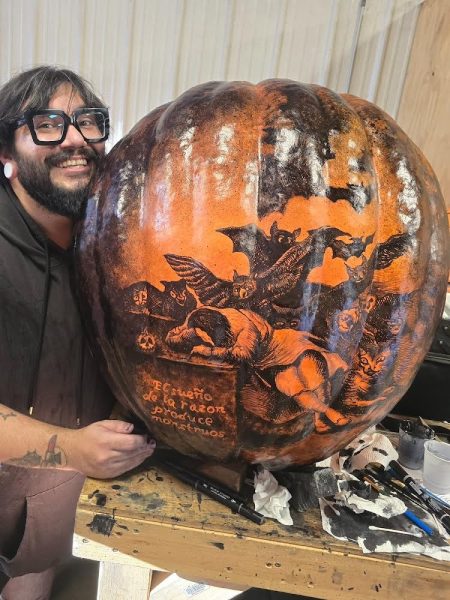
Two dozen artists work to carve the ornate pumpkins during a two-month period leading up to the event— designs range from animated characters to classic pumpkin faces to wild animals. Multimedia artist Justin Gregory has been carving for the MN Zoo for five years now, but says that he “had no idea that [he’d] be any good” at professional pumpkin carving. He credits his discovery of professional carving to an art school event in California a decade ago, but what truly got him started as a carver was an online job post for the Jack-O-Lantern Spectacular. They required Gregory to carve an “audition pumpkin,” as he dubbed it, and it was “love at first cut.”
Gregory says that pumpkin carving as an art medium brings with it a variety of unique challenges—“only about a million,” as he puts it. Pumpkins begin to rot the second you cut into them, have “slick skin” that can complicate the use of ink as a sketching medium, and come in a range of different sizes and shapes. Some are “200-plus pounds, and others are too narrow to stand by themselves.” Among his favorite designs he has created are the Creature from the Black Lagoon and Anya Taylor-Joy in the VVitch.
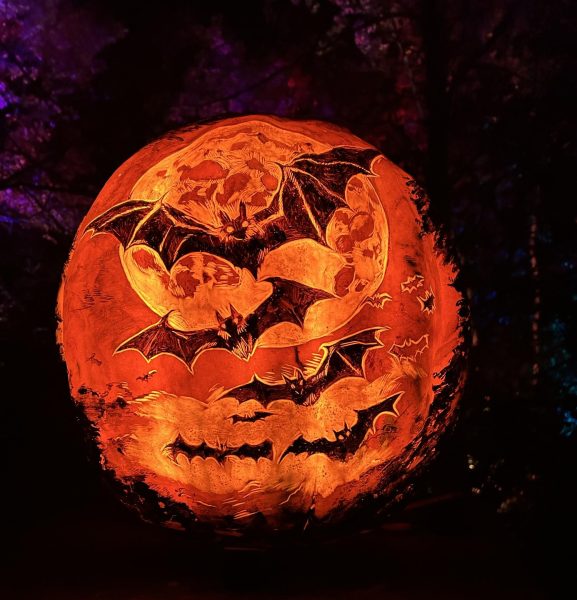
“There’s a certain beauty that comes with the impermanence of it,” Gregory observes. “[There’s] a sort of poetry in creating something while it’s dying at the same time.” He has a point—pumpkin carving is made all the more magical by the fact that both the pumpkin and the art on it are ephemeral, typically lasting for no longer than a couple of weeks. “Knowing that it’s going to be trashed can be very freeing,” says Gregory. Next time you’re carving a pumpkin, don’t stress about making it perfect—instead, focus on enjoying the process of creation and the beauty of temporary art.