





















The Minnesota Munchies: Uncovering Minnesota Food History
Though we aren’t especially well known for our food, there are a few iconic Minnesota creations that add to the culture and history of our state.
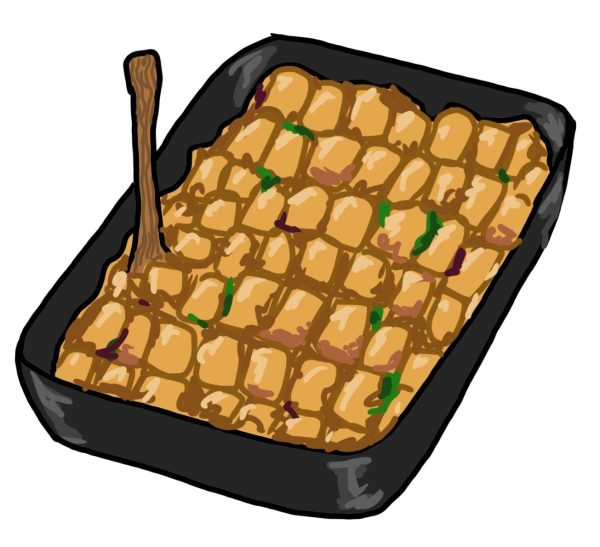
Tater tots were invented in 1953 by the Oregon frozen food company Ore-Ida. They repurposed potato scraps originally given to livestock, mashing them together to create tater tots. The Midwest soon adopted tater tots as one of their signature foods, and Minnesota eventually gave them their very own hotdish. The tater tot hotdish is now a staple throughout Minnesota appearing at family gatherings, church potlucks, and parties.
The hotdish is one of Minnesota’s most well-known dishes. It was invented during the Great Depression, when money was tight and people were hungry. Families started buying more canned soup, which they mixed together with whatever meat and vegetables they could afford. They put it all together in a dish, and that was their meal. After the Great Depression, the hotdish got more sophisticated, and began resembling the casserole.

Soon after, in the 1930s, SPAM was created to make use of the unpopular pork shoulder. It eventually became important during WWII because it was cheap to make, cheap to buy, and lasted a long time. It was named SPAM by Kenneth Daigneau, who won $100 for best name in a contest. It’s unclear if the name stems from “spiced ham” or if it’s an acronym for “Shoulder of Pork And Ham.”
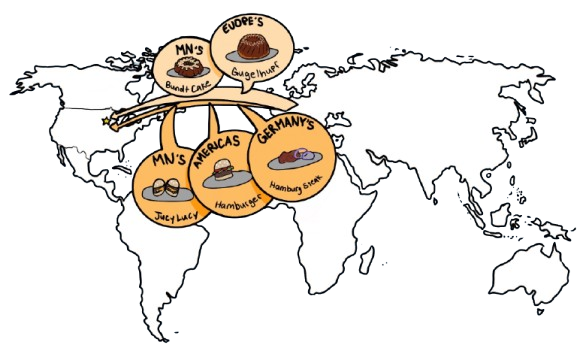
A few decades later, Minnesota had a wave of notable food inventions, including the Bundt cake and the Juicy Lucy. In 1950, a group of Jewish ladies from Europe came across a problem—the batter for their homeland’s Gugelhupf cake was too dense to be baked in regular pans. Their traditional pans, that were left behind when moving to the US, had a hole in the middle to ensure an even bake. Ultimately, they went to David Dahlquist, who owned Nordic Ware, a company based in St. Louis Park that made Scandinavian
bakeware. He happily crafted a lightweight aluminum cake pan with a hole in the middle to fit their needs. Dahlquist trademarked “Bundt,” which was the German word for a group “Bund,” with a “T” thrown on the end. It took a while, but eventually Bundt cake became a staple dessert in the US.

While the Bundt cake was being cooked up, a few restaurants in Minneapolis took another traditional German food and put a creative twist on it. Both Matt’s Bar and the 5-8 Club claim to be the first to invent the Juicy Lucy. Matt’s bar says that in 1954, a customer asked for a two-pattied burger with a piece of cheese in the middle. After eating it, he exclaimed how it was “one Juicy Lucy!” Matt’s bar describes how they then misspelled it as Jucy Lucy in their haste to add it to their menu (not the Juicy Lucy which they say is a “shameless ripoff”). The 5-8 Club tells a different story. They claim the Juicy Lucy (spelled with an i) came from their restaurant during the prohibition era, when they
were a speakeasy. All these iconic foods illustrate the colorful patchwork of Minnesota’s culinary history.
Ella’s Local Food Reviews
Brito’s Burritos is a fast, casual Mexican restaurant with a focus on customizable items such as burritos, tacos, and bowls. They have seven locations, including St. Cloud, Hopkins, Shorewood (which is located at 2413 Highway 7), and the location where it all started back in 2022: St. Louis Park. While similar to other customizable food restaurants, such as Chipotle, Brito’s Burritos prides themselves in their authenticity and fresh ingredients.
They skip the traditional shortcuts used in fast food to provide ingredients that are prepared day-of instead of stored in frozen bags. Personally, Brito’s Burritos is a favorite in my household because it’s quick, affordable, and tastes much fresher than many other burrito locations nearby. What makes Brito’s unique is that their burritos are not dense or greasy, especially given their ginormous size. The tortilla is chewy and light, and the ingredients are sweet and herbal. The originality and freshness of Brito’s Burritos ensures that the restaurant will continue to be visited frequently by my family and friends, and I strongly encourage those who enjoy Mexican cuisine to Burrito bowl give it a try.
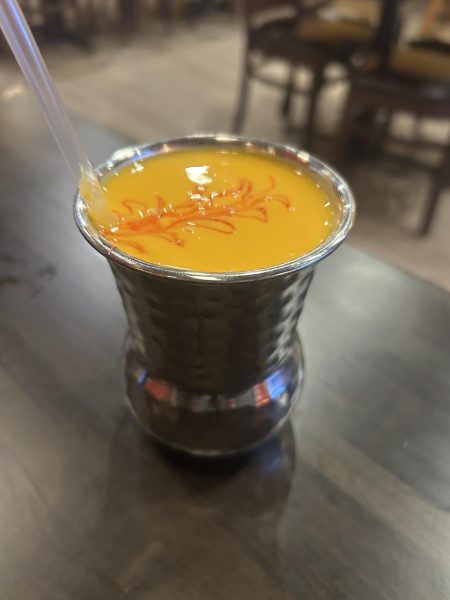
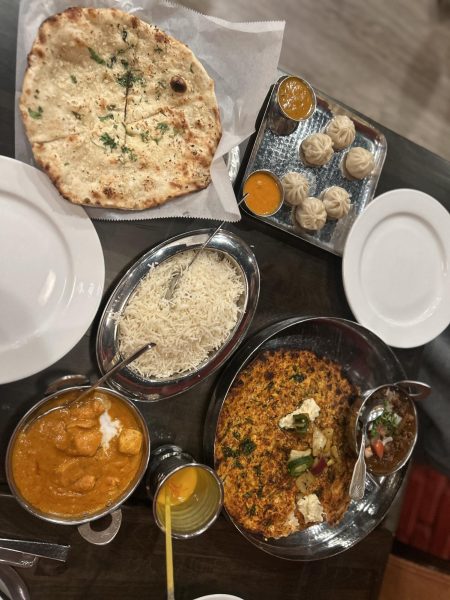
Thaliwala Indian Kitchen opened February 20, 2023, as a casual and affordable restaurant located at 7850 Market Blvd, Chanhassen, that serves authentic Nepali and Indian cuisine. According to a server named Kiran, who has been working at Thaliwala for about a year and a half, some of their most popular food items are from the curry and street food sections of their menu. These include chicken biryani, chole kulche, chole bhature, amritsari, and garlic naan. My family and I ordered and shared the amritsari, garlic naan, coconut curry, momos, and a drink called mango lassi.
At Thaliwala, the service was very welcoming and fast, but not overwhelming. The restaurant itself is vibrant and captures the spirit Mango lassi and culture of the cuisine in which they specialize. In relation to the food, the mango lassi was extremely creamy and had a strong yogurt flavor which was perfect to reset the palate after a very spice-based meal. The wrapping of the momos was neither thick and doughy nor thin and fragile, and the filling was rich but still light enough to be the perfect appetizer. The coconut curry was creamy, herbal, and a perfect balance between spicy and sweet. Even so, nothing in this meal could beat the amritsari, which was the star of the night. The rich and smoky gravy paired beautifully with the soft onion and potato filled bread. Garlic butter was dolloped on top, and melted into the warm bread with ease.
All in all, Thaliwala is a great place to find affordable and authentic Indian and Garlic naan Nepali food with exceptional service and a vibrant and welcoming atmosphere.
Minnesota Restaurants are Struggling
My parents met at a restaurant in Uptown called Bilimbi Bay. Now, 22 years later, my mom and I live 5 minutes away and Bilimbi Bay is long gone. It’s unclear why it closed, but it’s certainly part of a larger pattern of restaurant closure and turnover that is
deeply troubling.
In a CBS News article, Jeff Wagner highlights the steadily dropping number of restaurants, a fact backed up by the decreasing number of restaurant licenses applied for each year. In 2017, there were 1,791 total licenses in the twin cities, but by July of 2025, there were only 1,484. Even fewer than that are the number of licenses that were renewed. Wagner claims, “it’s potential evidence of more restaurants deciding to close.” But calling it a decision may be an oversimplification. Inflationary pressures, rising labor costs, and thin margins have forced many local establishments to permanently close their doors nationwide, and these issues have only increased since COVID.
My dad, who still works in the restaurant industry, saw first-hand the impact that COVID had. I remember being excited to spend more time with him as he occupied his time away from work with long family bike rides, but of course, it came at cost. He was unable to work for long periods of time, and this would prove devastating to both employees and businesses.
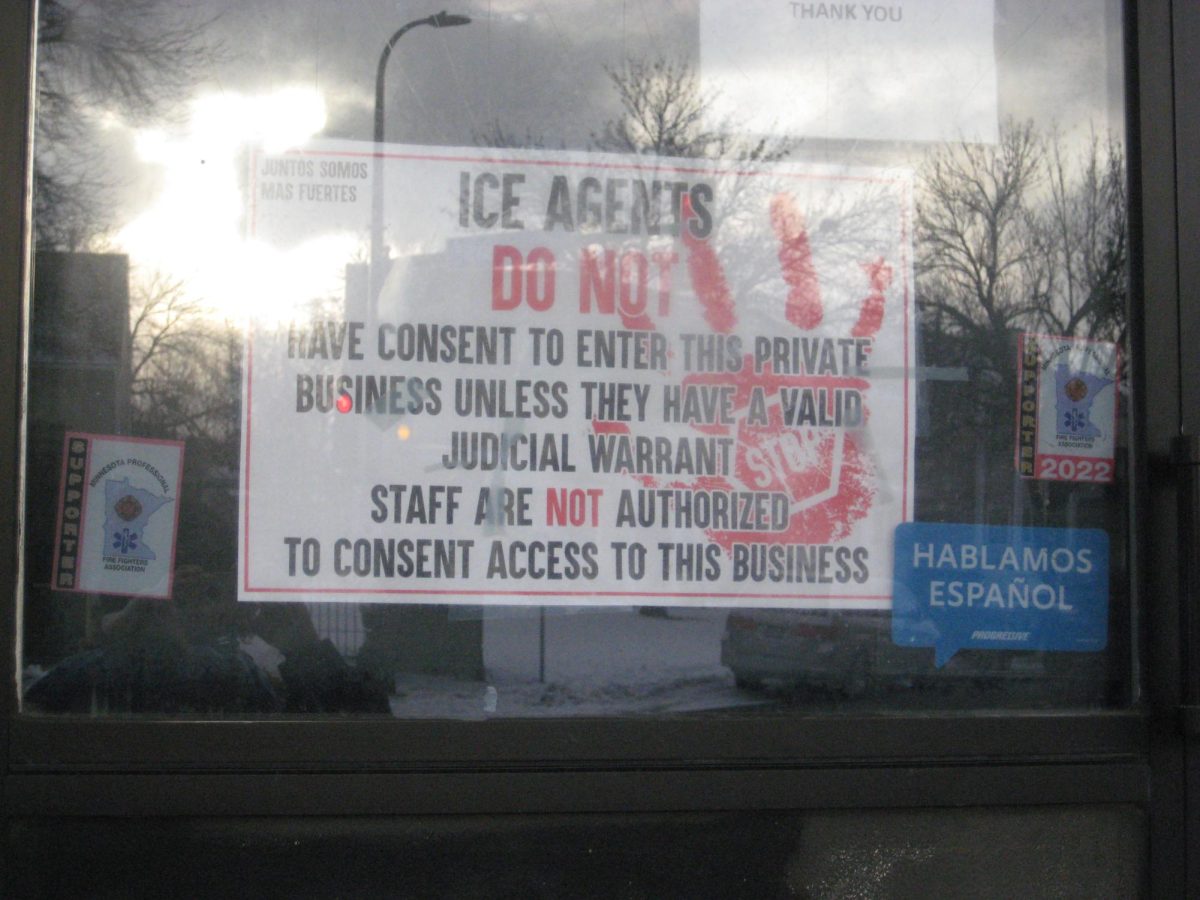
According to the Minnesota Hospitality Association, from 2020 to 2021 foodservice businesses saw their revenue reduce by $15 billion. More recently, Operation Metro Surge has created similar challenges. A report from the city of Minneapolis estimates that at least 750 businesses lost $20,000 dollars each week during the peak of ICE operations.
On February 14, 3 weeks after his murder, I visited Alex Pretti’s memorial site. A flood of flowers, candles, stuffed animals, and handmade signs spilled into the street as small groups of people gathered on “Eat Street” to pay their respects. My mom and I had gone to do the same, but additionally we wanted to support one of the many restaurants located on Nicollet. We assumed that
because it was a location at which ICE had been, that people may not feel safe enough to patronize the local eateries. As we walked into My Huong Kitchen, a charming Vietnamese restaurant, I was overwhelmed with pride. Minneapolitans had come from all over the city to do the same. It was an enormous display of the impact of patrons working together to keep their local businesses afloat.

Individuals aren’t the only ones helping the cause. On January 30 of this year, in response to the difficulties that Minnesota restaurants are facing, the Salt Cure Recovery Fund was founded to provide grants to businesses in need so that as many doors could stay open as possible. They provide money for rent, payrolls, mortgages, and more.
Salt curing is a method of food preservation, and Salt Cure’s goal is just that; to preserve Minnesota’s rich restaurant culture, and they plan to continue their efforts for as long as people are willing to donate. Restaurants are so important to the local economy, but honestly that’s not why I care about them. They are cultural anchors. They create space for celebration, community, and creativity. They make food from all around the world easily accessible, and are a large part of America’s “melting pot.” So many of my best memories with my family were about food from my favorite restaurants, and I literally wouldn’t be here without them.